

Updated November 10, 2026
A data governance platform enforces your data rules at the point where data is collected, so business units can keep building the forms they need without each one becoming a new data silo. This post walks through how those silos start, why governance matters even before you have a governance team, and why the form, where the data first arrives, is a good place to enforce policy. In Form.io, each form doubles as the data model and the API, and its validation runs in the browser and again on the server.
“I just need a quick form to manage this survey,” says the manager.
They head over to the quickest, freest form builder website and register for an account.
Within a few minutes and some drag and drop functionality, they build their form, hit publish, and send it out in an email—to a list of 5,000 people.
Piece of cake, done.
Within hours the manager is already getting some good feedback which is great. But pretty soon, the higher ups are asking more questions about what pricing plan those survey responders are currently using, or from which marketing campaign did they sign up.
“Okay, can be done, but will take a bit of time,” the manager’s thinking.
They’re going to have to export the responses to a CSV, do the same with the registration and marketing data, and then do some spreadsheet wizardry to map them together or import them into their BI software.
Chances are good that they’re going to run another survey next month, and that means doing all this work again. “I might need to hand this off to someone,” as the manager is thinking through the cumbersome work that’s ahead.
ALSO, did that freebie survey platform accommodate for privacy, PII, or GDPR requirements? They might want to check into that.
And that’s how IT begins.
What “IT” am I talking about?
I’m talking about the data siloing that naturally happens when teams are moving quickly to get their jobs done AND the manual work that goes along with processing that data.
How Data Silos Start When Teams Move Fast
As organizations grow, their data requirements become more sophisticated and require more governance around them. Why?
Never mind the potential privacy or PII concerns, but a one-off silo here and there might be okay, especially if your organization is small, but they tend to create painful problems down the road as individual business units continue to deploy transactional data processes without centralized coordination within a data architecture. What kinds of problems?
The Problems With Not Having A Data Governance Platform & Data Management Strategy:
- Data inconsistencies pop up across different systems that pollute analytics accuracy and hinder future integration efforts
- Complicates regulatory compliance requirements such as CCPA, GDPR, or others when data is not adhering to appropriate standards or lacks sufficient security oversight
- Data Integrations are non-existent or an afterthought which means spending more time tracking things down and processing that data for use, as described above
- Data gets misused, such as personal identifiable information (PII) is stored unsecured or in the wrong system
- Data errors can occur if the intake methods (forms) do not implement consistent validation across their various uses
Why Having A Data Governance Platform Matters
A crucial goal of data governance is to break down data silos, like the one I just described above. That manager has now created a silo of customer survey data in a third-party platform that is completely disconnected from the rest of the organization’s data.
Over time and left unchecked, multiple silos of disparate data can build up which makes time-wasting manual processes and future integration headaches worse.
Having a data governance strategy and policy also ensures that data gets used properly. Business units are less likely to misuse personal information and fewer errors will occur in the data.
Data governance also ensures data quality, beyond just avoiding errors. With a good data governance platform, you can ensure accurate analytics, ensure regulatory compliance, and improve the ease of access to other business units and analysts—all of which lowers costs.
Now, it’s possible to simply write down a policy that dictates how to handle various kinds of data, and that’s a good thing, but how do you enforce your data governance plan?
Enforcing Data Governance Before You Have a Governance Team
A Chief Data Officer, Data Governance Management Teams, Data Governance Committees, and Data Stewards are all roles that large organizations will hire to help define, implement, and enforce data governance.
These are all good and will help an organization achieve a robust data management strategy, but what if you’re not at that level where you’re ready to hire a full data governance team? And even if you are, you still have to implement something that enables the centralized coordination that I mentioned above. How?
Let’s Start At The Beginning: One Form Builder for Managers and Developers
In my scenario above, I described a manager who just needed a form builder to create a form on a URL to send out a survey. Depending on what they’re responsible for, that may be all they will ever need.
But that’s not all the rest of the organization needs. Even if that manager, individually, doesn’t need the data they collect to interact with other data in the business, there may be other stakeholders in the business that do need that data. Therefore, that data needs to be accessible across the organization.
Let’s say this organization wants to let these managers and business units continue to build forms as they need, BUT they also want to let their in-house developers build forms AND have the flexibility to embed those forms into various tools without any hassle. In other words, it needs to be a form builder for developers too.
While they’re at it, those forms would better serve the organization if they could pre-populate data from other systems and send data to various systems (on premise, in the cloud, legacy, third-party, whatever), so it would be helpful if they had a form builder for developers with an API backend to easily handle all the integrations required, no matter their sources.
As time goes on, the organization wants to formalize everything into an app that handles all the internal business processes. This app is going to require a number of forms.
And as users begin to use the app, a lot of data is getting created, manipulated, copied, moved, updated, and so forth and it’s working. The next evolution is to build additional business process applications and ensure that all of them are managing the data in a centralized, coordinated way.
At the end of the day, the organization needs a data governance platform that can handle any one of these scenarios that maintains data consistency, eliminates errors, conforms to regulations, and remains secure no matter the scope of its usage, across the whole enterprise:

A Data Governance Platform That Enforces Policy At The Intake
What better way is there to enforce data quality, formatting, rules, and routing than the moment the data is received?
This is why forms matter. A form is never just a form when they:
- Operate as the data model that is accepted within the organization
- Route data where it needs to go because they’re API driven
- Pre-populate data from existing systems because, again, they’re API driven
- Enforce formatting and quality policies with front and back end validation
- Adhere to security and compliance requirements when they’re embedded within your environment
Even if you don’t have a Chief Data Officer, Data Governance teams, or Data Stewards, the right data governance platform can ensure centralized, coordinated conformity across the organization.
This is what Form.io does.
And when it’s in place, all the data you’re receiving across your whole enterprise, no matter what you’re building, remains reliable, measurable, stored in-house when you self-host, and capable of being routed to where it needs to go.
What about the scenario with the manager from the story at the beginning who just needs a one-off form?
Form.io handles that too. Non-developers can build a form with drag and drop and in one click have it publicly accessible, and its data stays in the same platform instead of cropping up as another data silo.

What Data Governance at Intake Looks Like in Form.io Today
Here’s how the ideas in this post map to the product now, according to Form.io’s docs and feature pages:
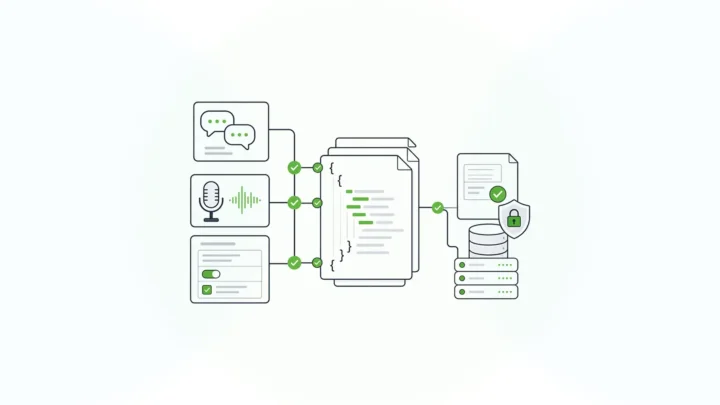
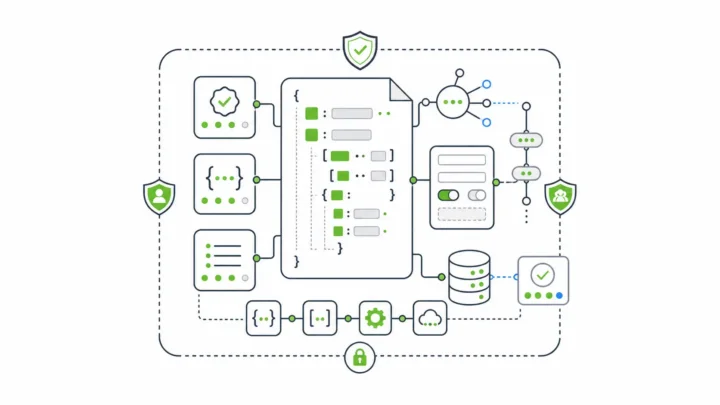
- One schema drives the form, the validation, and the API. Validation rules are defined once in the form’s JSON schema. The renderer checks them in the browser, and the API checks them again when the submission arrives, rejecting data that breaks the rules even if it skipped the browser entirely.
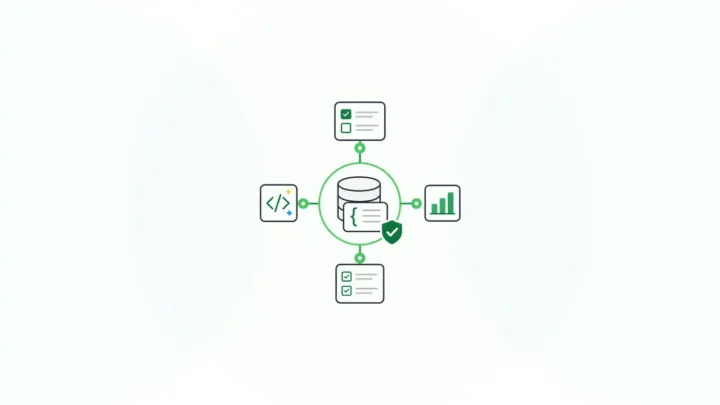
- Resources are the shared data model. A Resource defines the API and back-end data model as well as the front-end UI, and it can be used inside other forms. The Data Source component pulls data from a Resource into a form’s fields, so teams reuse the records you already have instead of starting new lists.
- Roles and permissions decide who reads and changes data. Each user gets a role, and roles map to the create, read, update, delete, and index permissions on forms and submissions. With OAuth/OIDC or SAML, your identity provider’s groups or claims map to Form.io roles.
- Actions route the data when it arrives. Actions run when a submission is created, updated, or deleted. A form can have several, such as sending an email, saving to a Resource, or calling a webhook that sends the data to another system.
- Business units can build forms inside guardrails. The Enterprise Form Builder Module embeds a pre-configured form builder in your own application. You choose which components are available and what can be built, and every form stays connected to the platform’s data model, APIs, permissions, and workflows.
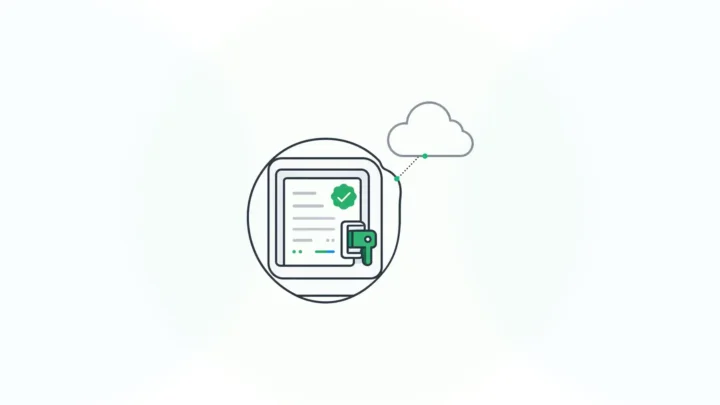
- Audit logs, revisions, and your own environment. The Security Module adds audit logging of user activity, plus form and submission revisions. A self-hosted deployment runs inside your environment under your network policies. Form.io supplies the technical controls, and your organization supplies the policies and certifications.
Sources: Form Conditional Logic and Validation That Runs Everywhere, Secure Forms: Form.io’s Security Module, Enterprise Form Builder Module, and the Form.io docs on Resources, Actions, and authentication and authorization. Keep reading: Data Governance Framework: How Signed Records Turn Policy Into Proof, Your Enterprise Data Governance Strategy Is Driven By Your Applications, and Off-The-Shelf Form Security That Developers Will Approve. Want to try it? Start a free 30-day trial or contact us.