

Jotform is a strong hosted form builder when the job is to create a form quickly.
That is not the same as choosing form infrastructure for regulated work.
If your forms collect sensitive data, drive downstream decisions, live inside a product, or need to satisfy audit and security teams, the real question is not only which builder is easiest. It is which platform gives you enough control after the form is submitted.
The Short Version
Most Jotform alternative lists compare templates, pricing, free plans, conditional logic, integrations, and form design.
Those things matter. They just do not settle the decision for regulated teams.
If your use case is a marketing form, event registration form, internal survey, or lightweight intake workflow, a hosted builder may be the right answer. If your use case is healthcare intake, government services, insurance claims, financial onboarding, customer portals, or embedded SaaS workflows, you need to evaluate a different layer.
For those teams, a serious Jotform alternative should be judged by:
- where the platform runs
- who controls submission data
- how authentication and permissions work
- whether forms generate APIs
- whether form and submission changes are auditable
- whether the form builder can be embedded and white-labeled
- whether the platform can fit into the systems you already govern
That is where Form.io belongs in the conversation.
Form.io is not the fastest option for a one-off hosted form. It is the stronger fit when forms become part of application infrastructure.
Why Most Jotform Alternative Lists Miss the Regulated Buyer
Most search results for jotform alternative are written for broad software shoppers.
They usually ask familiar questions:
- Which tool is cheaper?
- Which one has better templates?
- Which one is easier for a nontechnical team?
- Which one has the most integrations?
- Which one has the cleanest form design?
That comparison is useful for simple workflows. It is incomplete for regulated ones.
A hospital intake workflow, public-sector application, insurance claim, KYC onboarding flow, or embedded customer portal cannot be evaluated only by front-end form features. The submitted data becomes part of a larger system. It may need to be retained, corrected, audited, routed, exported, approved, signed, versioned, or tied to a specific policy decision.
That moves the decision out of the form-builder category and into the architecture layer.
The right question becomes: can the form platform respect the control surface around the form?
The Real Buying Question: Hosted Builder or Controlled Infrastructure?
There are two different jobs hiding behind the same keyword.
The first job is form creation. A team needs to publish a polished form, collect responses, and send data somewhere useful. Hosted builders are good at this. They reduce setup time, give nontechnical users a friendly workspace, and make common forms easy to ship.
The second job is governed data collection. A team needs forms to run inside a larger application boundary, use existing authentication, expose durable APIs, preserve record history, and support audit evidence when something changes.
Those are not the same job.
The first job rewards speed. The second rewards control.
That does not make hosted builders bad. It means regulated teams need to know when the category changes.
Where Hosted Form Builders Work Well
A hosted form builder can be the right choice when the workflow is narrow and the organization accepts the vendor-managed model.
Use a hosted builder when:
- the form is standalone
- the data does not need to stay inside your own environment
- the workflow can live in the vendor's dashboard
- standard integrations are enough
- nontechnical creation matters more than developer control
- the form does not need to become part of a product or governed application
This is why broad Jotform alternative lists often recommend tools like Typeform, Google Forms, Tally, Fillout, Cognito Forms, Formstack, FormAssembly, or other hosted builders. For simple forms, those recommendations can make sense.
Regulated teams should be more careful.
The moment the form sits inside a controlled business process, the tool has to answer questions that template libraries cannot answer.
Where Regulated Teams Need More Than a Hosted Builder

Regulated workflows usually fail at the edges.
The form itself looks fine. The problem appears after submission.
Who can see the data? Which system owns the record? What happens when the form schema changes? Can a historical submission still be understood against the form version that captured it? Did the webhook fire? Who changed the claim amount, diagnosis note, eligibility field, or approval status? Can the organization prove it later?
These are ordinary questions in healthcare, government, finance, education, insurance, and other regulated settings.
They also map directly to formal control programs. NIST SP 800-53 Rev. 5 organizes security and privacy controls across families such as Access Control, Audit and Accountability, Identification and Authentication, Incident Response, Risk Assessment, and System and Communications Protection. HHS says the HIPAA Security Rule establishes national standards for electronic protected health information and requires administrative, physical, and technical safeguards. A form platform used in regulated work does not sit outside those concerns. It becomes one of the places those concerns show up.
IBM's 2025 Cost of a Data Breach report gives the risk scale. IBM reports a global average breach cost of $4.4 million, and also reports that 63% of organizations lacked AI governance policies to manage AI or prevent shadow AI. Verizon's 2026 Data Breach Investigations Report adds another useful warning: software vulnerabilities now start 31% of breaches, which is why regulated teams should evaluate the form platform as software infrastructure, not only as a form-design surface.
Forms are one of those systems.
What a Regulated Jotform Alternative Should Prove
A regulated team should not start with "Which form builder is easiest?"
Start with the control requirements.
Deployment Boundary
Where does the platform run?
For some teams, vendor-managed SaaS is acceptable. For others, sensitive data must remain inside a private cloud, on-premise environment, government-approved network, customer-controlled database, or specific regional boundary.
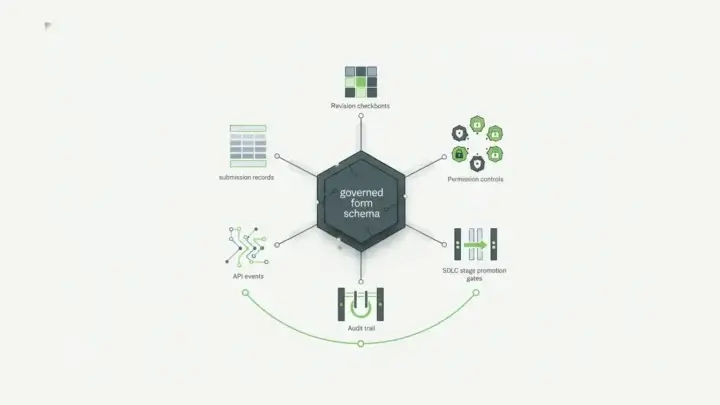
That is one of Form.io's clearest differences. Form.io's self-hosted forms for enterprise model is built so the platform can deploy inside environments the customer controls. The same core surfaces, including form builder, REST API generation, submission handling, and renderer libraries, can run within the customer's infrastructure.
This matters because deployment is not just an IT preference. It shapes data residency, incident response, logging, backup strategy, access review, and compliance ownership.
Data Ownership and Submission Control
The form response is not just a row in a vendor dashboard.
For regulated teams, a submission may become a patient record, claim record, case file, intake record, eligibility input, identity artifact, or workflow event. The platform needs to fit the system that owns that record.
Form.io's architecture stores forms, resources, submissions, users, and project data as JSON documents in the customer's MongoDB or MongoDB-compatible database. That document model is part of why Form.io can treat form definitions and submission records as application data rather than isolated form entries.
If your team needs application-owned data, this distinction matters more than builder polish.
Authentication and Permissions
Regulated forms rarely have one kind of user.
A healthcare intake flow may involve patients, providers, administrators, support staff, and compliance reviewers. A government service workflow may involve applicants, case workers, supervisors, auditors, and external systems. A SaaS product may need tenant admins, end users, implementation teams, and internal support roles.
The platform has to respect those boundaries.
Form.io's roles and permissions model is built around controlling who can create forms, view submissions, modify data, manage projects, and interact with APIs. That matters when the same form infrastructure supports different departments, customers, tenants, or workflow stages.
For regulated teams, permissions are not an admin convenience. They are part of the evidence trail.
Generated APIs
Many hosted form tools expose APIs. That does not mean the form is the API contract.
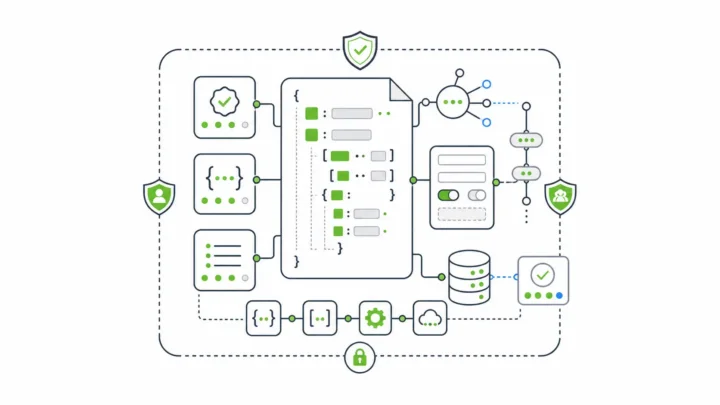
The stronger architecture is schema-driven: the same definition that renders the form also defines the submission structure and API behavior around it. Form.io's form from JSON model gives teams a JSON-based form definition that can render interfaces and support generated APIs from the same source.
This is useful when forms feed applications, not just spreadsheets.
It lets developers treat forms as governed application surfaces: forms, resources, submissions, validation, webhooks, and workflow actions can be reasoned about together instead of being scattered across a visual builder, a separate API layer, and custom glue code.
Audit Trails and Revisions
Regulated teams need to know more than whether a form was submitted.
They need to know what changed.
Form.io's complete audit trail capabilities distinguish between submission revisions and server audit logging. Submission revisions track field-level changes to submitted data. Server audit logging captures system activity such as authentication, form access, API requests, and data modification events.
That distinction matters. An auditor may need to know that a submission was created by one user, modified by another, and later viewed through a specific role or project context. A support team may need to know whether a webhook ran. A compliance team may need to know which form revision captured a historical record.
For financial services, this is not an abstract preference. The FTC Safeguards Rule requires financial institutions to monitor and log authorized-user activity and detect unauthorized access, use, or tampering with customer information. It also creates retention and change-management expectations around customer information systems.
Form.io's secure forms compliance readiness capabilities also include advanced audit logging, action logs, form revisions, submission revision logs, submission collections, and container security scanning as part of the Security Module.
That is a different category of answer than "the form has an activity log."
Embedded and White-Labeled Use

Many regulated forms do not belong on a third-party hosted page.
They belong inside a patient portal, citizen service portal, claims application, financial onboarding flow, education system, or B2B SaaS product.
That creates two requirements at once: the form needs to feel native to the product, and the form data needs to move through the product's security and workflow model.
Form.io is designed for embedded use. Developers can render forms inside their own applications, use the platform's APIs, and let business users modify schemas after the application is in place. For software teams, this is often the useful compromise: developers own the system boundary, while business teams can still manage many form changes without reopening every application ticket.
Comparison Table: Jotform Alternative Categories
| Category | Best fit | Strength | Risk for regulated teams |
|---|---|---|---|
| Hosted no-code form builder | Simple forms, surveys, registration, marketing capture | Fast setup and low technical burden | Data and workflow live primarily in the vendor-managed model |
| Hosted enterprise form suite | Business teams that need more compliance features and admin control | Better security, SSO, compliance options, support | May still be separate from the customer's application infrastructure |
| Industry-specific form tool | Narrow healthcare, education, legal, or government workflows | Better fit for one vertical's common use cases | Can be too narrow for cross-department or product-embedded workflows |
| Custom-built forms | Unique internal systems with strong engineering ownership | Maximum control | Expensive to build, secure, document, version, and maintain |
| Self-hosted form infrastructure | Regulated teams where forms are part of real applications | Deployment control, APIs, permissions, revisions, audit evidence, embedded use | Requires technical ownership |
The last row is where Form.io fits.
It is not the right answer for every team looking for a Jotform alternative. It is the right answer when the team has outgrown the assumption that forms are standalone assets.
Why Form.io Is Different From a Normal Form Builder
Form.io is easier to understand when you stop treating it as a lighter or heavier version of a hosted form builder.
It is infrastructure for forms and the APIs around them.
The visual builder creates schemas. The renderer turns those schemas into forms inside applications. The API server manages forms, resources, submissions, permissions, projects, and actions. The self-hosted deployment model lets the customer run that infrastructure inside their own environment.
That is why Form.io's own guidance is direct about fit. In Form.io's article on why teams should not use Form.io without a developer team, the product is framed as infrastructure software for software developers building custom applications, not a simple form builder for nontechnical users. In other words, it is the wrong choice if a marketing team needs a simple form live this afternoon, and the better choice if a software team needs forms to behave like governed application infrastructure.
That honesty is valuable.
The buyer who only wants speed should not be pushed into infrastructure. The buyer who needs control should not be pushed into convenience software that will fail later.
Proof That This Is a Real Deployment Problem
This is not theoretical positioning.
Form.io's public case-study library includes publicplan GmbH, where the project supported more than 400 public-sector services and 1,000+ forms with strict standards and a short timeline. That kind of workload is not a normal contact-form problem. It is a repeatable public-service infrastructure problem.
The same pattern shows up in customer sentiment. A Trustpilot reviewer described Form.io as useful for both integration and standalone use and praised support when users get stuck (Trustpilot). The wording is simple, but the integration point is doing real work. Regulated teams are rarely buying a form in isolation. They are buying a form layer that has to connect to the rest of the system.
When Form.io Is the Wrong Jotform Alternative
Form.io is not the right replacement if the team wants the fastest possible hosted form with the least technical setup.
Choose a simpler hosted builder when:
- the form is temporary
- the data is low risk
- the workflow is not part of a product
- the team does not have developers available
- vendor-managed hosting is acceptable
- the organization does not need custom API, identity, or audit architecture
That is not a failure case. It is buyer fit.
For simple forms, infrastructure can be too much.
When Form.io Is the Right Jotform Alternative

Form.io becomes the stronger answer when the form is part of the system.
That usually means one or more of these conditions is true:
- submission data must stay inside a controlled environment
- forms are embedded in a customer-facing application
- different users need different permissions
- submissions need to become application records
- the team needs APIs generated from form definitions
- changes to forms and submissions need revision history
- workflows depend on webhooks, actions, approvals, or integrations
- the organization needs audit evidence after submission
- the platform must support multiple teams, tenants, projects, or environments
These are the use cases where "easy form builder" becomes too small a category.
For those teams, Form.io's advantage is not that it hides complexity. It is that it gives the team places to put the complexity where it belongs: deployment, schema, API, permissions, revisions, audit logs, workflow actions, and application integration.
Key Takeaways
- A broad Jotform alternative list is useful for simple form-building needs.
- Regulated teams need to evaluate deployment boundary, data ownership, permissions, APIs, auditability, and embedded use.
- Hosted builders can work when the form is standalone and vendor-managed storage is acceptable.
- Form.io is strongest when forms become application infrastructure inside customer-controlled environments.
- The right choice depends less on builder polish and more on what must happen after the form is submitted.
FAQ
What is the best Jotform alternative for regulated teams?
The best Jotform alternative depends on the control requirements. If the team only needs a hosted form with better pricing or templates, a simpler hosted builder may be enough. If the team needs self-hosting, APIs, permissions, audit trails, revisions, and embedded application workflows, Form.io is a stronger fit.
Is Form.io easier to use than Jotform?
Not for simple hosted forms. Jotform is easier for nontechnical teams that need to create and publish forms quickly. Form.io is built for teams that need developer control, application integration, self-hosted deployment, generated APIs, and governance around forms and submissions.
When should a team avoid Form.io?
Avoid Form.io when the form is simple, standalone, low risk, and needs to be created by a nontechnical user without developer involvement. Form.io expects technical ownership, especially for self-hosted deployments and production application integration.
Why would a regulated team outgrow a hosted form builder?
Hosted form builders can become limiting when the workflow needs controlled data residency, internal authentication, custom permissions, API-driven records, audit logs, revision history, or direct embedding inside a product or portal. Those needs turn the form into part of the application architecture.
Does Form.io support self-hosted forms?
Yes. Form.io can be deployed in customer-controlled environments, including cloud, private data center, and Docker-based deployments. That gives teams more control over where form infrastructure runs and how submission data fits their existing security boundary.
Does Form.io generate APIs from forms?
Yes. Form.io's schema-driven model uses form and resource definitions to support REST API behavior around submissions, validation, resources, permissions, and workflow actions. That makes it useful when forms are interfaces into application data, not just hosted pages.
Is Form.io HIPAA compliant?
Form.io provides technical capabilities that can support HIPAA-governed workflows in customer-controlled environments, but the customer remains responsible for its compliance program, configuration, policies, deployment controls, and business associate requirements.
Does a BAA make a form workflow compliant?
No. HHS explains that business associate contracts define permitted uses, safeguards, breach reporting, access, amendment, accounting, subcontractor, and termination obligations. A BAA matters, but compliance also depends on how the workflow is configured, secured, monitored, and governed.
Why do audit trails matter for form submissions?
Audit trails help answer who accessed data, who changed it, what changed, when it changed, and which workflow action ran. For regulated teams, that evidence can matter as much as the original submission.
Can Form.io be embedded inside a SaaS product?
Yes. Form.io is designed for embedded application use. Developers can render forms inside their own applications, connect them to Form.io APIs, and let authorized business users manage form schemas after the product infrastructure is in place.
What should I ask before choosing a Jotform alternative?
Ask where data is stored, who controls deployment, how permissions work, whether APIs are generated from the form schema, how revisions are handled, whether audit logs are available, and whether the form can live inside your own application or portal.
Build Regulated Form Infrastructure With Form.io
If you only need a quick hosted form, choose the simplest tool that satisfies the job.
If your forms define application workflows, submission records, permissions, APIs, audit evidence, and deployment boundaries, choose infrastructure that respects that reality.
Try Form.io for regulated form infrastructure.
Try Form.io for free