
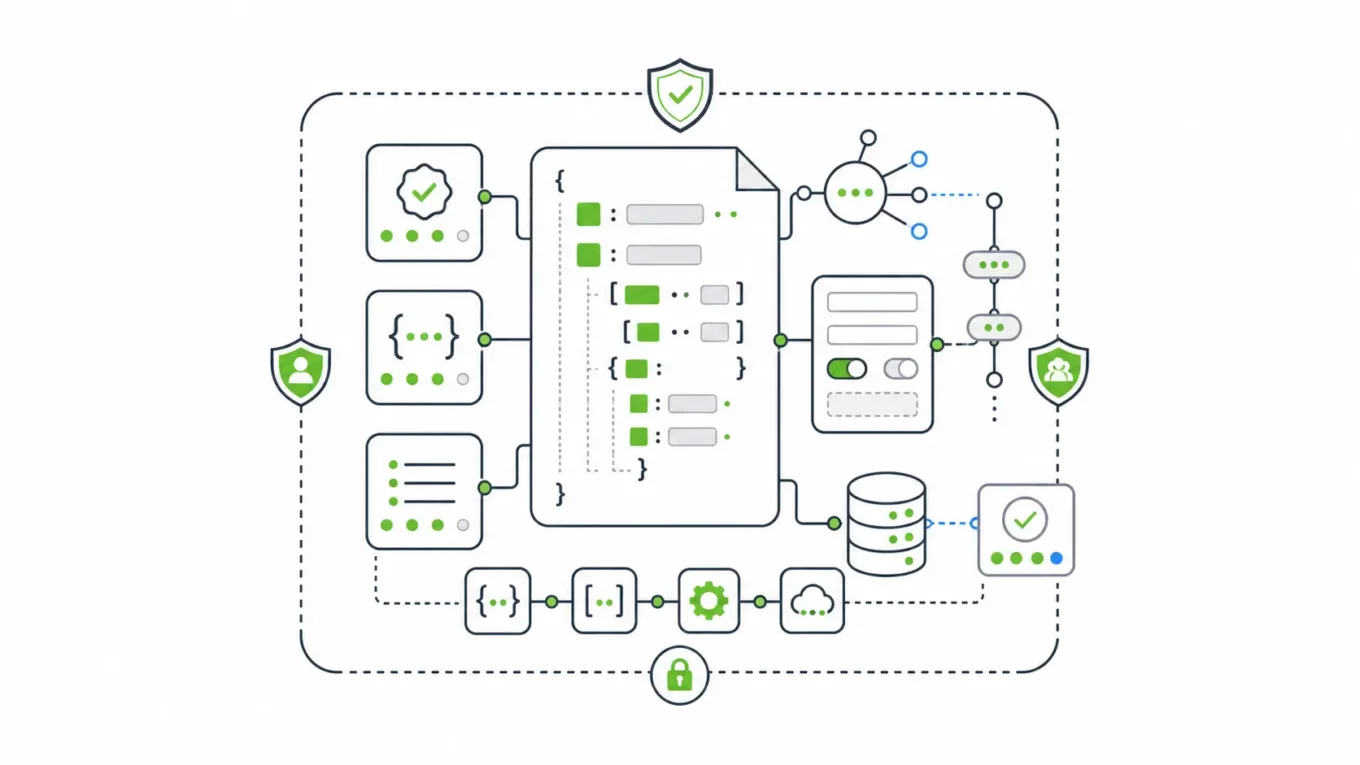
Searches for json schema validator often start with a simple need: check whether this JSON payload matches this schema.
That is useful. It is also only the first layer.
In a production app, a schema may validate API requests, generate a form, drive documentation, define a submission shape, feed an AI tool, or become part of a governed application contract. The right tool depends on which job the schema has to do.
Key takeaways
- A JSON Schema validator checks whether JSON data conforms to a declared structure, types, required fields, constraints, and references.
- Online validators are useful for quick checks, but production teams usually need runtime libraries, CI checks, API contract tooling, or form infrastructure.
- Ajv, Python
jsonschema, and Java validators solve the library problem. They do not own form authoring, submissions, permissions, or deployment governance. - Form generators turn schema into UI, but the backend still has to store, secure, expose, and govern submitted data.
- Form.io fits when schema needs to become form and API infrastructure: builder, renderer, submissions, generated APIs, permissions, workflow actions, revisions, and customer-controlled deployment.
Quick answer: which JSON Schema validator tool should you use?
Use an online validator when you need to test a small schema and sample payload quickly.
Use Ajv when your JavaScript or TypeScript application needs fast JSON Schema validation in Node.js, the browser, an API gateway, or a build process.
Use Python jsonschema when your Python services need to validate instances against JSON Schema drafts and report validation errors in application code.
Use a Java validator such as NetworkNT when JSON Schema validation belongs in a JVM service, API layer, or request/response validation path.
Use Spectral or a schema lifecycle tool when the problem is not one payload, but API governance, linting, bundling, testing, and CI.
Use RJSF, JSON Forms, or SurveyJS when the goal is to generate a form interface from structured schema.
Use Form.io when the schema must become production form infrastructure: a human-facing form, submission record, generated REST API, workflow surface, permission boundary, and governed deployment model.
What a JSON Schema validator actually proves
JSON syntax validation and JSON Schema validation are different jobs.
A JSON syntax validator answers: is this valid JSON?
A JSON Schema validator answers: does this valid JSON match the structure and rules the application expects?
That can include object shape, required fields, string formats, numeric ranges, enum values, array constraints, nested objects, and references to other schema definitions.
The official JSON Schema site describes JSON Schema as the vocabulary that enables JSON data consistency, validity, and interoperability at scale (JSON Schema). The specification hub also separates JSON Schema Core from JSON Schema Validation, where validation defines the keywords used to assert whether data is valid (JSON Schema specification).
That distinction matters because many production failures are not syntax failures. They are contract failures.
The payload is valid JSON, but it is missing the field the downstream service expects. The field exists, but the type changed. The UI allowed a value that the backend rejects. The API docs say one thing, but the runtime accepts another. The schema was copied into three services, and now nobody knows which version is authoritative.
A validator can catch part of that. It cannot, by itself, decide where schema ownership lives.
The five tool layers behind the search
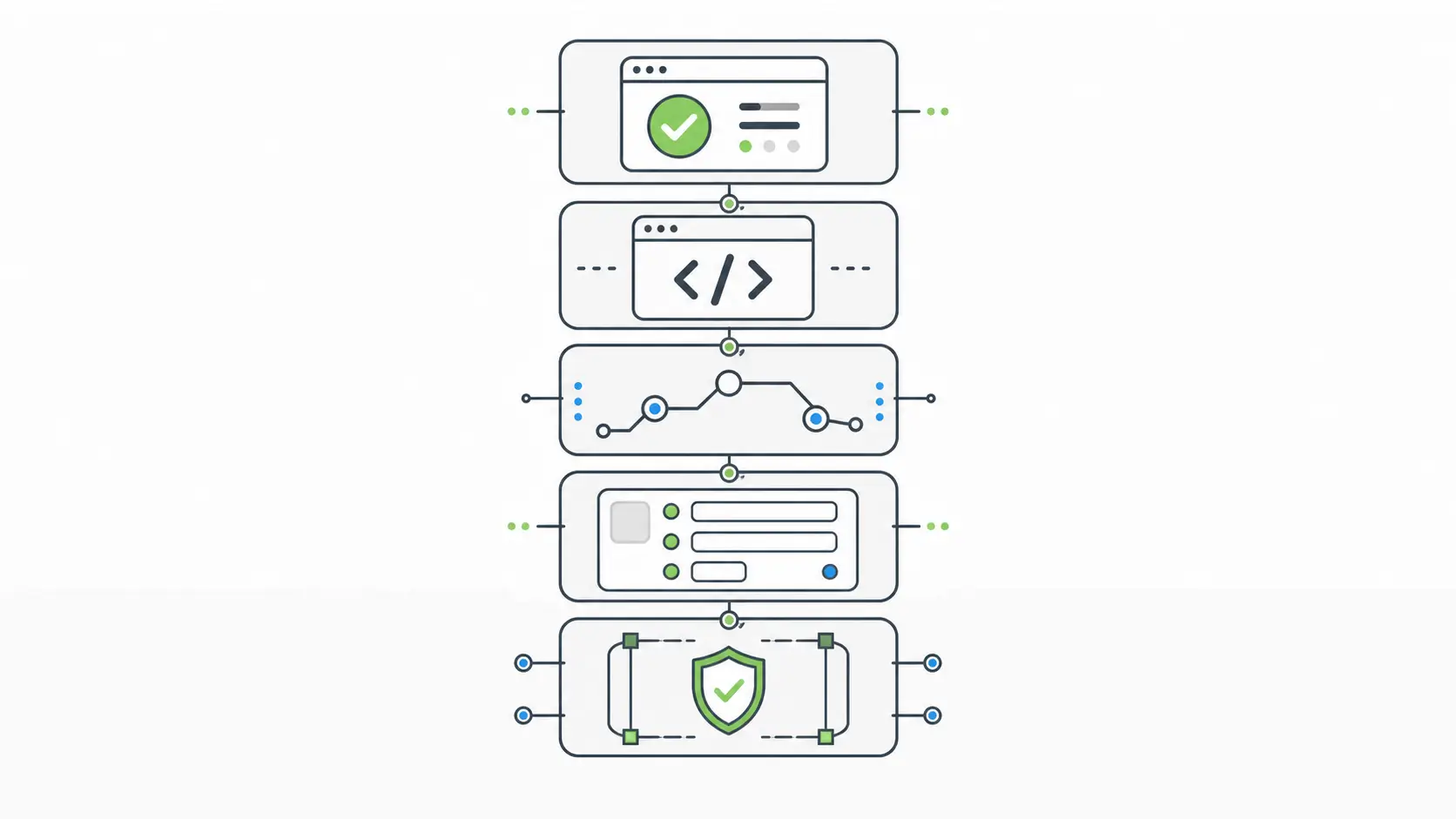
The search result page for json schema validator looks crowded because people use the same phrase for several different jobs.
| Tool layer | Best fit | What it proves or creates | What the team still owns |
|---|---|---|---|
| Online validator | Quick testing and debugging | A sample JSON instance matches a schema | Production runtime, security, CI, versioning |
| Runtime validator | API requests, service boundaries, app code | Payloads satisfy schema rules in a language/runtime | UI, storage, workflows, governance |
| API contract tooling | OpenAPI, linting, docs, API style rules | API definitions follow a contract and style rules | Form authoring, submissions, application state |
| Form generator | Rendering forms from schema | A schema can produce a user-facing form | Backend APIs, permissions, data lifecycle |
| Form/API infrastructure | Production forms, APIs, submissions, workflows | Schema governs form UX, submission shape, generated APIs, and data handling | Product fit, deployment ownership, policy configuration |
The mistake is asking, "What is the best JSON Schema validator?" without asking, "What part of the system needs validation?"
Online validators are useful, but limited
Online validators are useful for quick checks. They help developers paste in a schema, paste in sample JSON, and see errors immediately.
That is often exactly what the searcher wants.
But online validators should not become the production validation strategy. They are poor places for sensitive payloads. They do not enforce validation in your application. They do not live in CI. They do not control what happens after data is accepted.
Use them like a scratchpad.
For production, validation needs to move into the system path: application code, API gateway, test suite, CI pipeline, schema registry, form builder, or platform boundary.
Runtime validators: Ajv, Python, Java, and the application path
Runtime validators belong where your application receives, transforms, or emits JSON.
Ajv is the obvious JavaScript and TypeScript example. Its documentation says it supports JSON Schema draft-04, draft-06, draft-07, draft 2019-09, draft 2020-12, and JSON Type Definition (Ajv schema language guide). Snyk's package database currently lists Ajv at more than 272 million weekly npm downloads, which shows how deeply validation libraries can sit inside the JavaScript ecosystem (Snyk Ajv package page).
Python teams commonly reach for jsonschema, whose documentation shows the simple validate function and the validator classes behind it (Python jsonschema validation docs).
Java teams may use NetworkNT's JSON Schema Validator, which describes support for multiple drafts and OpenAPI 3 request/response validation (NetworkNT JSON Schema Validator).
These tools are important because validation should happen where the system can reject bad data before it spreads.
The practical checklist is straightforward:
- Confirm which JSON Schema draft or dialect your validator supports.
- Reuse compiled validators where the library recommends it.
- Decide whether validation should fail fast or collect all errors.
- Make error messages useful enough for logs, developers, or users.
- Treat
$ref, remote references, and bundled schemas as design choices, not incidental details. - Benchmark against your actual schemas and payload sizes if validation runs in a hot path.
Runtime validators are the right answer when the job is validation.
They are not the whole answer when the same schema also needs to create forms, APIs, permissions, workflows, submission records, and audit evidence.
API contract tools: where JSON Schema meets OpenAPI
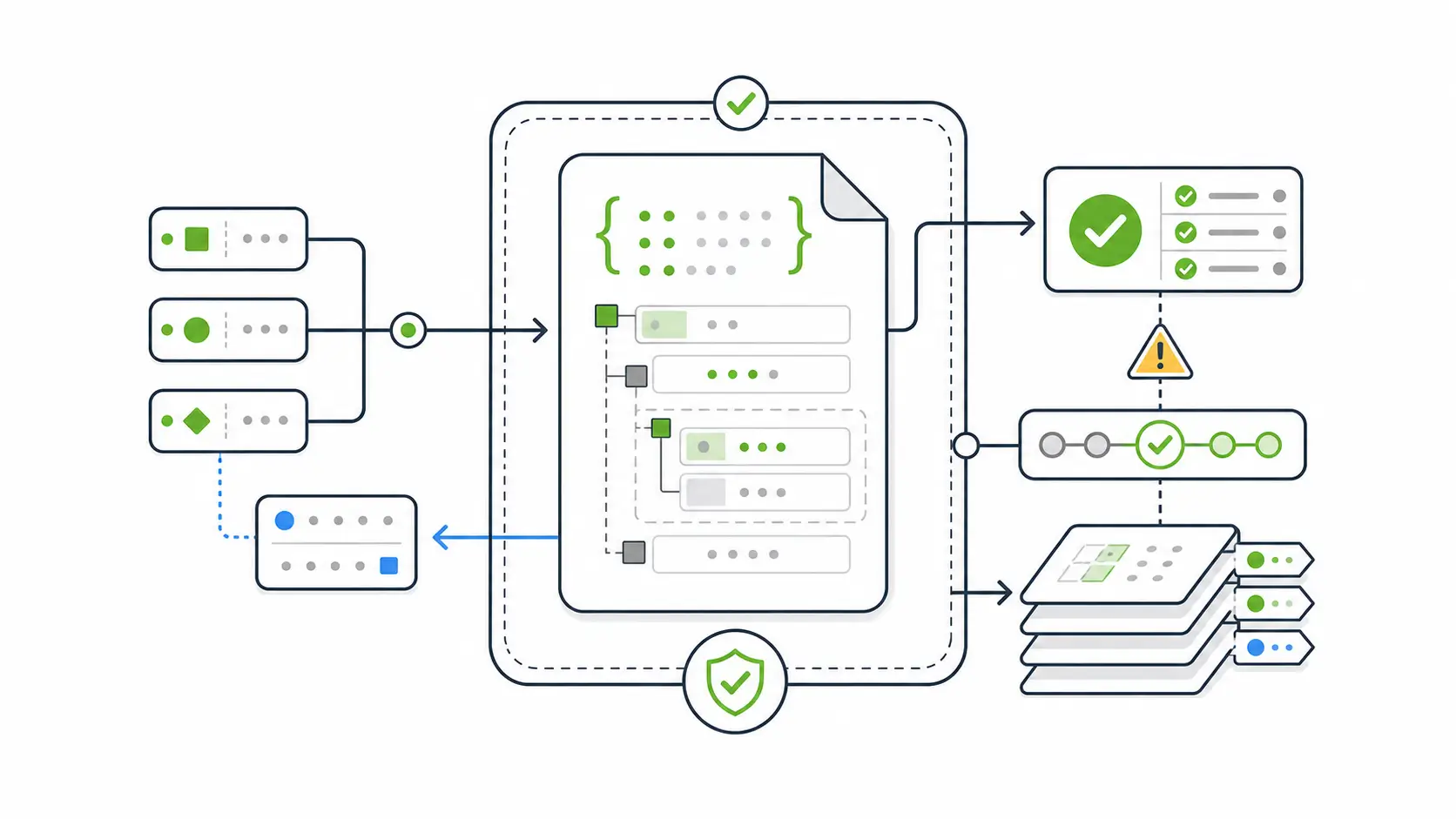
For API teams, JSON Schema often appears through OpenAPI.
The OpenAPI Initiative's 3.1 release announcement says OpenAPI Schema Objects are now fully compatible with JSON Schema draft 2020-12 (OpenAPI 3.1 release). That matters because the schema can become part of request validation, response validation, documentation, mock servers, SDK generation, and contract testing.
This is where tools such as Spectral fit. Spectral is a JSON/YAML linter designed with OpenAPI, AsyncAPI, and JSON Schema in mind (Spectral). A validator asks whether data satisfies a schema. A linter can ask whether an API definition follows a team rule.
That is a different level of governance.
For production apps, the better question is not "Can we validate this object?" It is:
- Can we keep the API contract and implementation aligned?
- Can we catch drift in CI before release?
- Can we enforce style and security rules across many APIs?
- Can generated docs, mocks, clients, and tests inherit the same contract?
That is where JSON Schema starts becoming part of operational discipline.
Schema lifecycle tools: keep schemas from becoming loose files
When schemas are shared across teams, a single validator is not enough.
Schema files need formatting, linting, testing, bundling, versioning, and promotion through environments. The official JSON Schema tools page shows how broad the ecosystem has become, including validators, documentation generators, schema-to-code tools, schema-to-web-UI tools, benchmarks, and compliance reports (JSON Schema tools).
Sourcemeta's JSON Schema CLI is a good example of the production-lifecycle layer. Its repository describes a CLI for maintaining schema repositories and ensuring quality during local development and CI/CD, including formatting, linting, testing, and bundling (Sourcemeta JSON Schema CLI).
This layer matters when a schema is not a one-off file. It is a source artifact.
If multiple services, teams, or applications depend on it, schema changes need review. References need to resolve. Tests need to run. Breaking changes need to be understood before they reach production.
That is the point where teams stop treating JSON Schema as an isolated validator input and start treating it as part of the application contract.
Form generators: when schema becomes UI
Some teams search for a JSON Schema validator and really need a form generator.
RJSF, for example, is a React component capable of building HTML forms out of JSON Schema. JSON Forms is another JSON Schema-based form renderer with data binding, validation, and rule-based visibility.
These tools are useful when a team wants schema to reduce repetitive form UI work.
But a form generator still leaves major production questions open:
- Where are submissions stored?
- Which API receives the data?
- How are permissions enforced?
- How are form changes versioned?
- How do non-developers safely edit forms?
- How does the schema move between dev, test, and production?
- What happens when the form becomes part of a regulated workflow?
A React JSON Schema form can render fields. That does not make it a form platform.
This is the line Form.io crosses.
Where Form.io fits
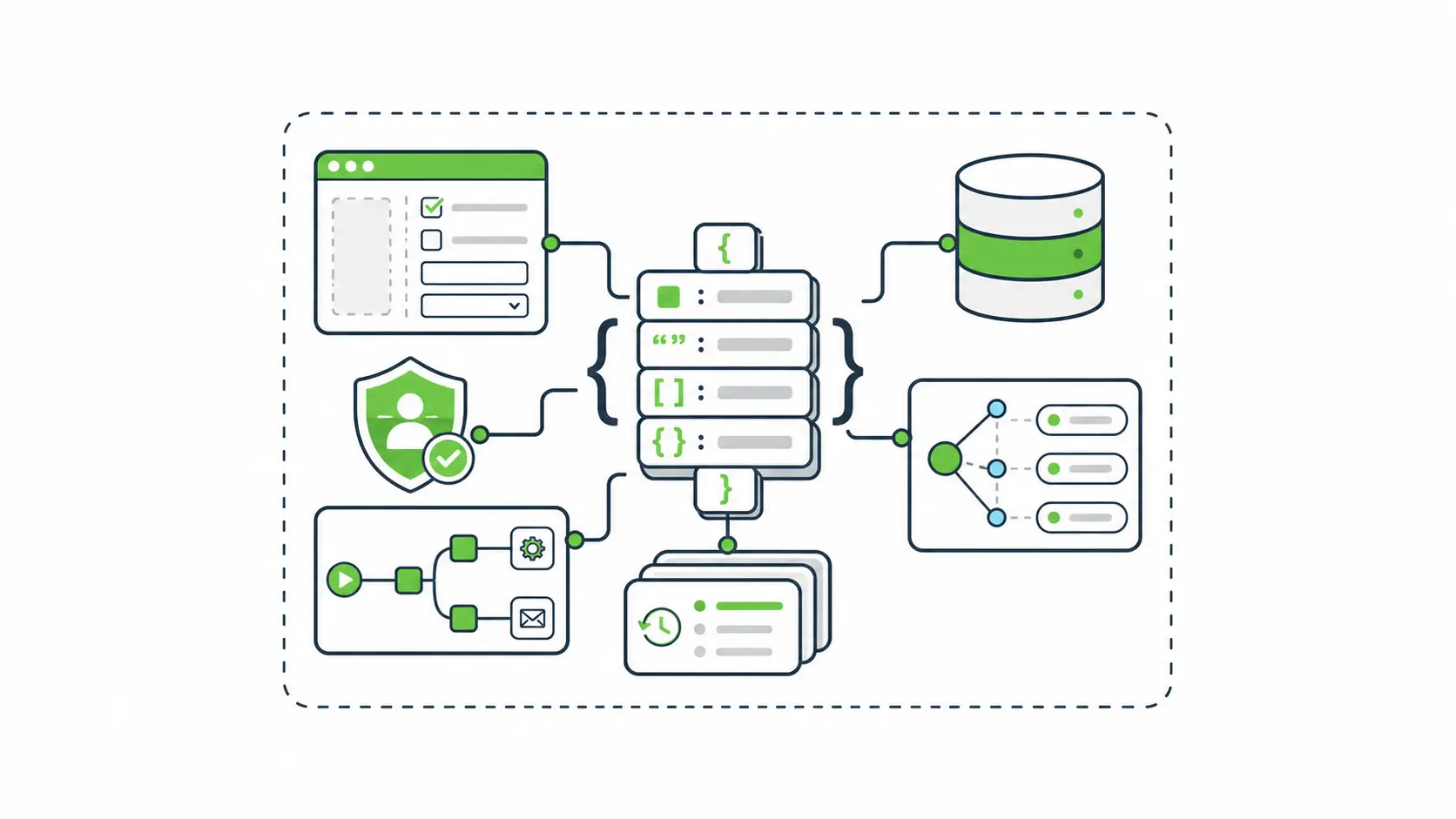
Form.io belongs in this conversation only after the lower layers are clear.
It is not a replacement for Ajv, Python jsonschema, the JSON Schema specification, or OpenAPI tooling.
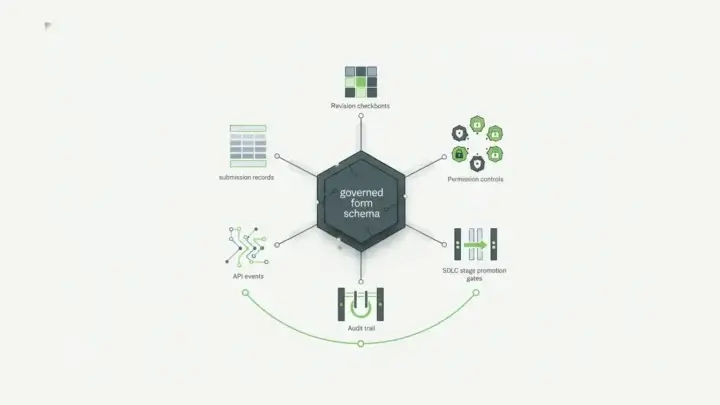
Form.io is the better fit when schema needs to become form and API infrastructure.
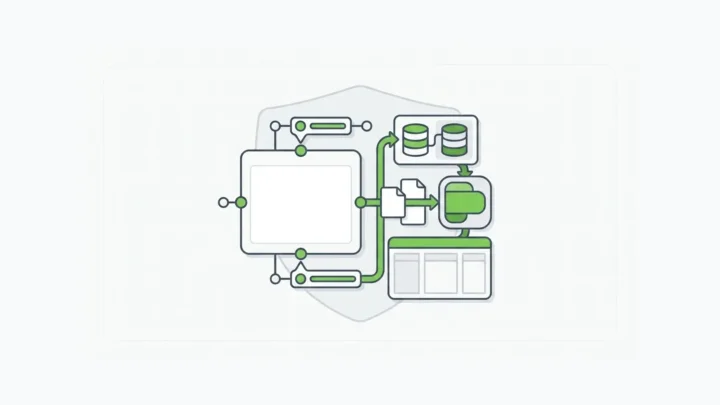
Form.io's Form JSON documentation says Form JSON defines the structure, appearance, and functionality of a form, and that the schema is used for rendering forms, generating REST API interfaces, and hosting the form schema for embedding (Form.io Form JSON docs).
Its feature documentation also explains that the builder outputs JSON schemas rather than static HTML, and that the same schema defines the UI, validation rules, data model, and REST API endpoints (drag-and-drop form builder and APIs).
That is the infrastructure difference.
A validator can say, "This payload is valid."
A form generator can say, "This schema can render a form."
Form.io can connect the form definition, rendered experience, submission data, generated API, permission model, workflow actions, revisions, and deployment boundary.
That includes the operational pieces validators do not try to own: self-hosted form deployment, form revisions, complete audit trails, secure forms compliance readiness, and fillable PDF workflows when the submitted record also needs document output.
That matters for teams building customer portals, healthcare intake, insurance claims, government services, financial onboarding, internal approval workflows, and B2B SaaS products where forms are part of the application architecture.
There is also customer proof behind this pattern. G2's indexed Form.io reviews include a State of Ohio pandemic-response example where Form.io was used to stand up forms, store and present data through an API, and feed analytics dashboards. The same reviewer called the model "easy to manage" across hundreds of websites (G2 Form.io reviews).
Form.io's own customer proof makes the same point from the build-vs-buy side. Edify.ai said speed to market with Form.io "worked fantastically well" and that the team could focus development time on proprietary work instead (Form.io customer proof).
The honest framing is this:
Use a JSON Schema validator when validation is the job.
Use Form.io when the schema needs to become a governed form, API, and submission system.
A production checklist for choosing JSON Schema tools
Before choosing a tool, answer these questions.
1. Where does validation happen?
Validation may belong in the browser, backend service, API gateway, test suite, CI pipeline, ETL job, or form platform.
One schema may need several validators in different places. That is normal. The risk is when each surface evolves its own slightly different rules.
2. Which schema version do you support?
JSON Schema draft support is not trivia. Draft-07, 2019-09, and 2020-12 do not behave identically.
Pin the version. Document it. Make sure your tooling supports it before using draft-specific keywords in production.
3. Who owns schema changes?
If schemas define production behavior, they need ownership.
A change to a field, type, required value, nested object, or reference may affect UI, API behavior, stored submissions, integrations, reports, and historical records.
4. Is the schema only validating data, or generating behavior?
If the schema only validates API payloads, a runtime library may be enough.
If the schema renders forms, generates APIs, controls submissions, and drives workflow behavior, the decision belongs at the platform layer.
5. What happens after validation passes?
This is the question most validator pages skip.
Where does the data go? Who can see it? Can it be edited? Is there revision history? Does it trigger a webhook? Can the workflow be audited? Can the platform run inside your environment?
If those questions matter, you are no longer only choosing a JSON Schema validator.
Key takeaways
JSON Schema validators are necessary tools, but the phrase hides several different jobs.
Online validators help with quick checks. Runtime validators enforce contracts in code. API tooling keeps definitions consistent. Schema lifecycle tools keep shared schemas maintainable. Form generators turn schema into UI.
Form.io is for the next layer: production forms and APIs governed by schema, with submissions, permissions, workflows, revisions, and deployment control attached.
That is the practical distinction. Do not make a validator carry the full application burden. Use the validator where validation belongs, and choose infrastructure when the schema becomes infrastructure.
FAQ
What is a JSON Schema validator?
A JSON Schema validator checks whether JSON data conforms to rules described in a JSON Schema. Those rules can define object structure, required fields, data types, arrays, enums, numeric limits, string formats, and references to other schemas.
Is JSON validation the same as JSON Schema validation?
No. JSON validation usually means checking whether the text is valid JSON syntax. JSON Schema validation checks whether valid JSON data matches an expected schema.
What is the best JSON Schema validator for JavaScript?
Ajv is one of the default choices for JavaScript and TypeScript teams. It supports multiple JSON Schema drafts and is widely used across Node.js and browser environments.
What is the best JSON Schema validator for Python?
Python teams commonly use the jsonschema package. It implements JSON Schema validation and provides validator classes, error handling, and draft-aware behavior.
Can JSON Schema generate forms?
Yes, some tools can render forms from JSON Schema. RJSF and JSON Forms are common examples. The important distinction is that rendering a form does not automatically provide backend APIs, submission storage, permissions, or workflow governance.
Does OpenAPI use JSON Schema?
OpenAPI 3.1 aligns its Schema Object with JSON Schema draft 2020-12. That makes JSON Schema more important for API contracts, documentation, request and response validation, and API tooling.
Should I paste sensitive data into an online JSON Schema validator?
For sensitive production data, avoid it. Online validators are useful for examples and debugging, but regulated or customer data should be validated inside tools and environments your team controls.
What should production teams check before choosing a validator?
Check draft support, runtime support, error quality, performance, custom formats, $ref handling, CI integration, schema bundling, and how schema changes are governed over time.
Is Form.io a JSON Schema validator?
Form.io is not best understood as a standalone JSON Schema validator. It is a schema-driven form and API platform. It uses schema to help govern forms, submissions, generated APIs, permissions, workflows, and deployment control.
When should a team use Form.io instead of only a validator library?
Use Form.io when the schema needs to operate a production form workflow, not just validate a payload. That includes embedded forms, submission records, generated REST APIs, permissions, workflow actions, revisions, and self-hosted deployment.
Can Form.io work alongside validators like Ajv?
Yes. A production architecture can use validation libraries at service boundaries while using Form.io for the form, API, submission, and workflow layer. The key is deciding which system owns each contract.
If your schema needs to do more than validate JSON, try Form.io for free and see how forms, APIs, submissions, and workflow controls can live on one foundation.
Try Form.io for free