

Updated November 17, 2026
An enterprise data governance strategy is easiest to keep when it’s built into the applications your teams already use: standardize the forms that collect data and the APIs that route it, and people follow the policy because the tools already do. This post explains why data collection and routing are the keys, then shows the before and after of hand-coded forms versus Form.io’s JSON-driven forms.
You have carefully crafted processes and procedures. Your organization lives by them.
Things need to be done in a specific way so that the integrity of everything you do and everything you deliver is maintained.
That’s why your customers trust you. Your systems are integral to enabling your teams to deliver the results your customers expect, day in and day out.
Yet, when it comes to technology, especially custom applications that manage data—its collection, routing, storage, etc., this is hard to do.
One developer from the next might have a different approach to building the data management components within your applications or prefer a specific provider for transactional emails, CDNs and data storage, or authentication.
The last thing you want is different processes and services within applications across the different groups in your organization that are creating unnecessary procedural load, data silos, and ultimately inconsistent experiences among your end users.
That’s why enterprise organizations in 2025 are looking for technology standardization solutions WITHOUT the strings that are commonly attached to monolithic approaches, such as:
- Migrating a bunch of data to something new
- Having to work with an opinionated, 3rd-party data management solution that forces you to build your applications in a specific way that’s not flexible
- Paying a lot more when usage of third party tools starts to scale up
- Dealing with security and compliance concerns, especially if your data is being stored somewhere outside of your environment
- Facing vendor lock-in if the solution doesn’t work out.
To avoid these pain points, many organizations opt to build something custom, in-house, even if it could take 1000s of dev hours and a lot of expense to build it.
But you don’t have to build ALL of it from the ground up. In fact, you already don’t.
You’re already buying or sourcing your database, email provider, authentication schema, cloud environment, etc.
And none of these technologies prevent you from building the custom, bespoke applications your organization needs.
Form.io does the same thing for everything orbiting around data collection (forms) and routing (APIs), without you having to migrate data, without opinionation that limits flexibility, without storing data outside of your organization, and without feeling trapped if you decide to change vendors when everything is JSON based and exportable.
The most composable technology asset just might be JSON, but that’s another topic.
I’ve said this before. It’s not whether you make vs buy something, it’s what you make vs. what you buy.
The point is that data collection and routing are the keys to standardizing your data governance strategy. How you handle these two things changes everything.
Let me explain.
A Tool Is Worth 100,000 Words: Standardize Governance With Forms And APIs
If you’ve ever written a detailed policy for “how we do things,” or a step-by-step procedure to help ensure everyone on a team adheres to the same standards, you know that once you get into the weeds, there could be 10 different scenarios and 100 variables that you have to think through to ensure that the job is done right every time.
Let’s say you get over that hurdle and have successfully written everything down, with screenshots and a video example.
Inevitably, someone is going to break procedure and do it differently for any number of reasons, perhaps because “it’s easier this way,” or “I didn’t have time to go through the whole thing.”
Or maybe there isn’t an enterprise-wide policy or procedure governing these things in the first place.
Point is, these variations create downstream discrepancies and non-uniform experiences for other team members, application end users, and customers that have negative effects.
As these variations add up over time, you’ll have some data end up in the CRM, some in spreadsheets, and some in third-party services. And none of this stuff talks to each other. Plus you’ll have to send people through retraining, and no one likes that.
But what if the procedure merely said “Duplicate this template and drag this component into your form,” and that’s all that needed to be said, because it was:
Pre-configured to pull data from a legacy system
Pre-configured to ask the end-user for a specific set of data
Pre-configured to route it to the CRM
Pre-configured to store the file upload in a specific AWS bucket.
Pre-configured to email a PDF copy to 2 other groups and the end-user.
And so on.
When the process is this simple, this standardized, it’s hard for your teams not to adhere to the data governance strategy you’ve implemented. They’re not likely to want to do it any other way. The strategy is driven by your applications, both internally and customer facing, working together.
Here’s the thing. The details of your data governance strategy may change. The legacy system might eventually be retired. Your enterprise might switch to Azure instead of AWS. You may migrate to a new CRM. New data collection fields might get added. Your brand might change.
Any of the points on one end of the chain or the other may change, but forms and APIs that move data between these things will still be needed.
That’s why they’re the key. The form is the entry point to the applications. The APIs are the roads. The destinations may change, but the way you get there will almost always be through a form and API. Form.io:
- Standardizes Form Definitions & Behaviors
- Standardizes APIs & Routing
- Standardizes Authentication
- Standardizes 3rd-Party Integrations & Services
- Standardizes CX/UI/UX
Form.io standardizes how you customize.
The Before And After With Form.io: Hand-Coded Forms Vs. JSON-Driven Forms
Too often these things are hand-coded. Each form, one by one, like this:

If you have 100s or even 1000s of forms and some of them have 100s of fields, this is going to be a long process to build.
- Each form has to be integrated into your app with its own view
- onSubmit controllers need to be written for each form to handle validations and post to different end points.
- A backend developer will need to write the endpoint for each.
- Whenever a change to a form needs to happen, new software has to be released.
- Each form requires its own db queries
But with Form.io:
- A single view services multiple different UIs
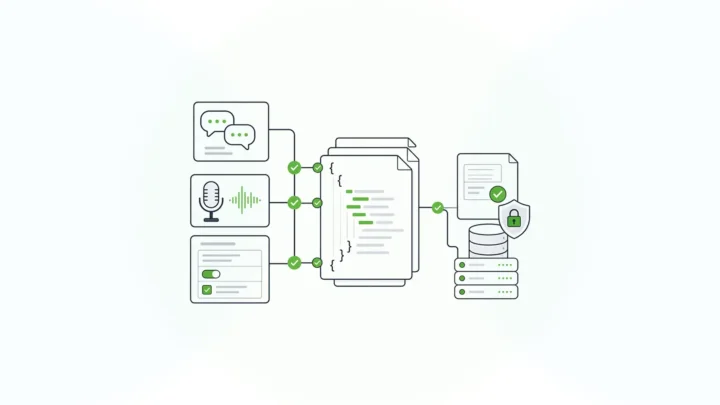
- No controller is necessary since the form JSON tells the SDK how to post the data to the Form.io API
- REST APIs are generated for you as the form was built via drag and drop, with validation, logic, etc. that you defined
- Changes to forms don’t require SDLC
- You can webhook submission data in real time to your own backend services for custom data processing and Form.io will submit the data to your own database.

All of this is deployed by the way—in your environment. Which means you keep control of your data. And we don’t price on usage either—only configuration. So whether your applications gather 10,000 or 1,000,000 users, the configuration price remains the same.
How Application-Driven Data Governance Works In Form.io Today
Here’s how the “drag this component into your form” idea maps to Form.io now, based on Form.io’s product pages and docs:
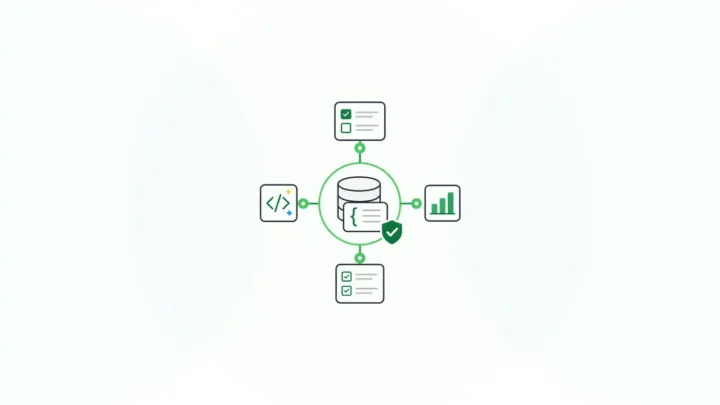
- One data model for forms and APIs. Resources define the API and back-end data model as well as the front-end UI, and they can be used inside other forms, so teams reuse the same data objects instead of creating their own.
- Routing is configured, not hand-coded. Actions run when a submission is created, updated, or deleted. A form can send an email, save data to a Resource, or use a webhook to send the submission to other applications or databases, and conditions can decide when each action runs.
- Start from a template. A project holds the Resources and Forms an application needs, and you can create one from scratch or from an existing pre-built template.
- Business units build inside guardrails. The Enterprise Form Builder Module (EFBM) embeds a pre-configured, white-labeled form builder in your application. You choose the components and what can be built, and every form stays connected to the platform’s structured data, APIs, permissions, and workflow behavior.
- Form changes still get a lifecycle. Self-hosted enterprise configurations include multiple stages in a project, and Form.io runs in your own development, testing, and production environments.
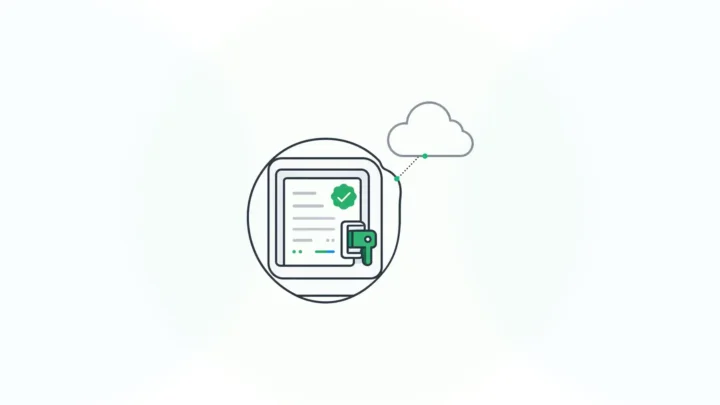
- Your environment, configuration pricing. Form.io is delivered as Docker containers that you deploy in your own environment, attached to your own databases. Pricing is per project and per API/PDF environment, not per form, submission, end user, form builder, developer, or API call.
Sources: How Form.io Works, Configuration-Based Pricing, Enterprise Form Builder Module, Enterprise Self-Hosting, and the Form.io docs on Resources and Actions. Keep reading: A Lean Data Governance Platform That Eliminates Data Silos While Maintaining Business Unit Autonomy, Data Governance Framework: How Signed Records Turn Policy Into Proof, and Data Collection Software for Enterprise Forms and APIs.
If you want to know more about Form.io, start a free 30-day trial or reach out to us: