

In insurance, forms are also:
- the UI a human (or agent) fills out
- the validation that checks it
- the API that moves the data
- the record saved in your database
- the audit trail a regulator will read
Insurance knows this well. Form.io provides forms that provide all this and more, running inside your own infrastructure, setting insurance workflows up for success with clean, structured data that can integrate with any new or existing system.
Schedule A CallForms are a pain insurance already knows
Familiar pains across insurance are, in truth, form problems. To name a few:
- Intake: A submission arrives as a scanned ACORD form, the data has to be OCR’d into a system of record, and no one has confirmed that the data is complete or correct. The carrier loses time and money before the risk is ever read.
- Underwriting: An underwriter rekeys unverified data by hand and spends time on data entry instead of risk assessment, and missing values go unnoticed for far too long. Quotes go out late, go out wrong, or get fixed downstream.
- Claims: First notice of loss arrives across a phone call, an email, and a set of photos, and someone re-enters it into a claim file to correct the data. Gaps in the data surface at adjudication, where they cost the most, and a claim that could close cleanly churns instead.
- Servicing: Endorsements, certificates, and cancellations run through a system built for new business, handled as exceptions and disconnected from the original submission. The backlog grows and production slows.
- Compliance: A regulator asks who changed a field across every intake form, and the answer sits inside manual processes spread across several people. Assembling it costs time and money the carrier planned to spend elsewhere.
Now AI builds the forms, and agents fill them out
Building Forms: You can build forms easily. AI has made this even exponentially faster. And that looks good at first glance, but what is missing is a standardized way forms are built which can scale over use cases, teams, and time. Forms are easy, and the tip of the iceberg. Without a standardized layer to enable form building with intention, downstream data issues are being built without knowledge of what is being caused. With Form.io, Forms are easy to build, and then embed in your own software applications for full control over data, workflows, branding and behavior. Form.io also provides all the Agentic Coding tools you need to succeed in building new applications and modernizing existing brownfield apps and systems as well.
Filling out forms: Agents now do this work at runtime. They complete forms and run workflows directly, filing a claim, triaging a submission, or issuing an endorsement. Whatever an agent submits inherits the validation, the access control, and the audit trail of the form in question. An agent can approve a claim or bind a policy, and no record exists of who decided what, on which data, and under which rule. Agentification of a regulated process can fail when an agent is running on a form that is not backed by a trustworthy infrastructure.
What is Form.io?
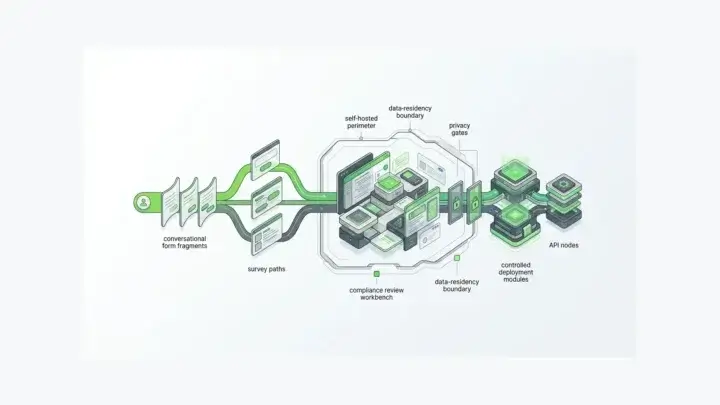
Form.io is the governed data-collection layer for regulated enterprises. When you build a form, you are building a single schema that defines not only the form, but also the data validation, the APIs to send data anywhere, the data model itself, the access permissions and audit trails for everything that is happening.
Form.io runs inside your own infrastructure as containers you deploy, acting as the foundational data layer for Insurance Software. Applications running on Form.io send structured data to your systems of record through the auto-generated APIs and webhooks that can reach any system, new or legacy. Your policy admin and claims platforms, such as Duck Creek or Guidewire, stay in place, and Form.io standardizes the data before it reaches them.
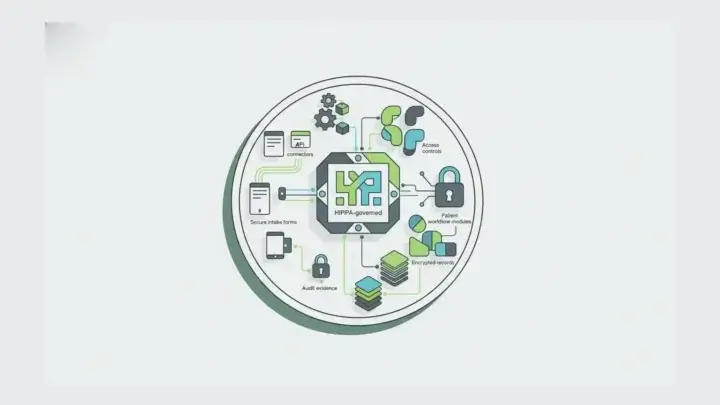
Because Form.io runs in your infrastructure, your data never leaves your security boundary. You maintain your own certifications, such as FedRAMP or HIPAA, on your own terms, and Form.io provides the audit trail, change control, and access control those certifications depend on.
Here is how that looks across claims, underwriting, and servicing:
- Claims intake: FNOL is captured as structured data at the point of entry, so no one has to reconstruct things from an email or a PDF later. The form enforces a complete, in-good-order claim before it moves from this point, so when the claim reaches adjudication, it is already guaranteed to be complete and accurate.
- Underwriting submissions: ACORD forms, statements of values, and loss runs become governed schemas with validation happening when the data is being filled out. The submission is structured and validated before it arrives, and it reaches the underwriter without a rekeying step necessary.
- Policy servicing: Endorsements, certificates, cancellations, and renewals run on the same standardized layer and inherit the same change control as new business. Every transaction records who changed what, and on which data.
Two add-ons that matter for insurance:
- Form.io PDF Server renders forms as an accessible web form OR as a pixel-perfect PDF, as the exact regulator-approved form. Even when filled out as a PDF, the data is reportable as soon as it is captured, and no extraction of data is needed downstream.
- Form.io E-sign+ provides a self-hosted digital signature solution as part of the form workflows themselves. Stop sending data to costly 3rd party systems that require a different document of record than what already exists as part of your form workflows. The signer, the timestamp, and the exact data signed all live in one record, with the same audit trail as everything else.
“Building A CRM Took 2 Months Instead Of 2 Years”
How E-Risk Services, LLC, A Specialty Lines Underwriting Subsidiary of Nationwide Insurance Company Went Lightspeed Building A CRM—And They’re Just Getting Started




Agentic automation fails without a secure foundation
An agent is only as trustworthy as the system it runs on. Regulators already expect a written, auditable account of how an automated system reaches a decision in a regulated line, and an agent running on an ungoverned form cannot produce this. Give that same agent a governed schema, with validation, access control, and a full audit trail, and it can do real work that holds up to an audit. Form.io is that secure foundation.
The Universal Agent Gateway is a service that agents connect to at runtime of an agentic workflow based application. Every action an agent takes is governed through the same form schema, the same access rules, and the same audit trail as humans utilizing the same system.
The rule that governs a person governs an agent, because both run on the same standardized foundation within a software application.
Meet us at ITC Vegas.
September 29 to October 1, Mandalay Bay. Bring your messiest line of business, and we will show you what one schema does with it.