
For enterprises that need self-service form building without losing control

Embed Form Building Directly In Your App

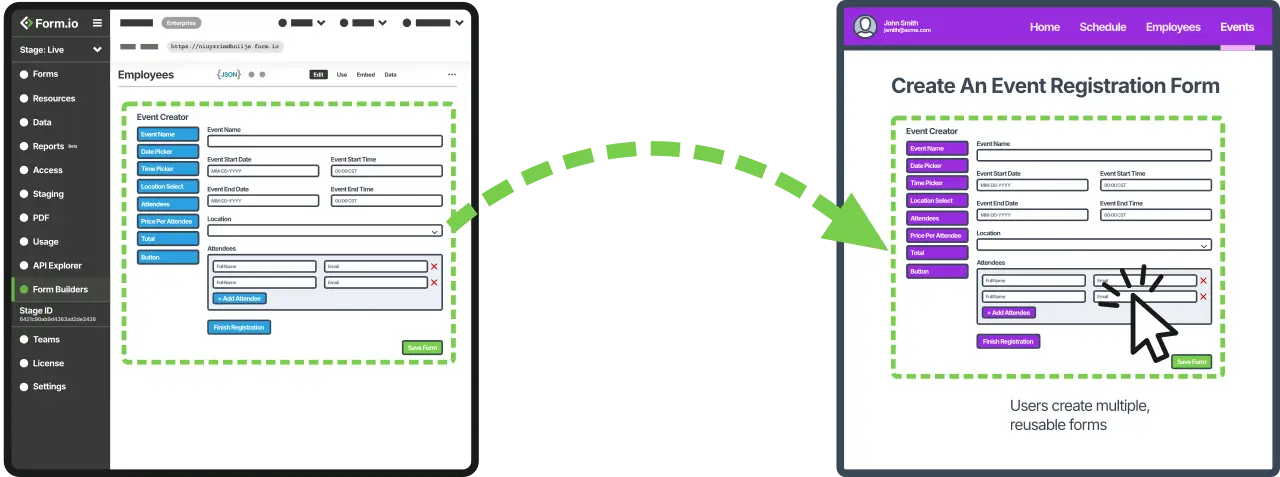
Give internal teams or customers a white-labeled, pre-configured form builder inside your application so they can build the forms they need without waiting on your team, while you keep the structured data, governance, and workflow integrity your platform depends on.

Enterprise Form Builder Module for embedded customer self-service
Self-Service Form Building For
Customers Product Teams Customer Support Marketing Teams Operations
Form request backlog

If Form Building Stays A Developer Function, Your Customers Wait And Your Backlog Grows

Every new form request becomes a ticket, a delay, and another round of manual configuration your team has to own.

Without Embedded Form Building

  • Your customers send requests every time they need a new form or a variation for a new office, team, or workflow.
  • Your developers become the bottleneck for layout, branding, rules, routing, and release timing.
  • Building your own form builder means also building permissions, validation, lifecycle management, and governance around it.

With The Enterprise Form Builder Module

  • Your customers can self-serve by building their own forms inside your application.
  • You control the guardrails, data model, and workflow behavior while exposing only what your platform should allow.
  • You scale software, not headcount, because form creation stops living in your support queue.
Embedded form building inside your application

What You Are Actually Embedding

Not just a drag-and-drop UI. A governed, connected, white-labeled form building capability that lives inside your platform.

The Enterprise Form Builder Module lets you expose form building to your customers within your own application experience. That means your users get autonomy, but they do not get chaos.

You can pre-configure components, constrain what can be built, preserve your branding, and keep every form connected to the Form.io platform's structured data, APIs, permissions, and workflow behavior.

So instead of handing customers a disconnected builder, you embed a controlled extension of your product.

Why Enterprises Use EFBM

Because the goal is not just letting customers make forms. The goal is letting them manage their own workflows without breaking your platform.

White-labeled form builder

White-Labeled In Your Experience

Your customers never leave your product. The builder is exposed under your brand, inside your workflows, with the experience you want them to have.

Pre-configured customer autonomy

Pre-Configured Customer Autonomy

Let customers create what they need inside the boundaries you define, so self-service does not become a governance problem.

Structured and AI-ready data

Structured, AI-Ready Data

Forms are connected to JSON-driven data structures and APIs, which makes downstream automation, routing, and agent workflows far more reliable.

Scale software, not people

Scale Software, Not People

Remove an entire class of repetitive support work from your team and turn form delivery into a product capability instead of an ongoing service burden.

Built For Platform Companies Serving Complex Customers

Especially when every customer, office, agency, or business unit needs some variation of the forms and workflows inside your application.

1

Customer-Facing Platforms

Your customers need to create and manage forms as part of the product experience, not by emailing your support team.

2

Multi-Office Or Multi-Group Operations

Each office, department, or tenant needs its own forms and process variations, but you still need one governed platform strategy.

3

Enterprise Workflow Applications

You need the forms, the data, and the workflow logic to stay connected because the forms are only the visible tip of the business process.

Are You Going To Build This From Scratch?

Because the hard part is not drawing a form on the screen. It is everything required to make embedded form building viable in an enterprise product.

White-labeling. Permissions. Component constraints. Validation. Structured data. Workflow routing. Governance. Auditability. Long-term maintainability.

The Enterprise Form Builder Module lets you expose a proven form building capability inside your application without taking on the cost, risk, and distraction of building the builder yourself.

What the Enterprise Form Builder Helps You Avoid

  • Building an embedded form builder as a standalone engineering project.
  • Manually servicing endless requests for new forms, revisions, and workflow-specific variants.
  • Creating disconnected forms that look flexible on the surface but break your data and process standards underneath.

How Enterprises Use It

Configure the capability once, expose it in your product, then let customers move faster inside guardrails you control.

1

Configure

Define the components, rules, branding, and workflow boundaries appropriate for your platform and your customers.

2

Embed

Expose the builder directly inside your application so form creation happens where the work already lives.

3

Scale

Let customers create what they need while your platform keeps the data structured, branded, governed, and connected.

Turn Form Requests Into A Product Capability

Embed a white-labeled form builder in your app so your customers can self-serve, your team can stop chasing tickets, and your platform can keep the structured data and workflow discipline enterprise buyers expect.

Form.io is Trusted By Enterprises Building Complex, Regulated, Form-Driven Applications

Accenture logo
Booz, Allen, Hamilton logo
Corel
Deloitte
ICANN Logo
LexisNexis logo
Northwestern University
State of Ohio logo
Pepsico
Takeda
Get Answers

Need More Answers?

Ask and we'll get back with you in 1 business day.

Contact Us

Send us a message to contact support or ask a question.

Schedule a meeting

Open Source Platform

Read our FAQ to find out what exactly is Open Source

View the Platform Documentation

View the API Documentation

View the Open Source Code

Learn More

Learn How It Works

Read the Release Notes

Discover Industries that use Form.io

Read our Blog