

See how embedded form creation changes the support, product, and engineering equation.
A customer needs one more intake screen, a different field label, or a form that matches how their team actually works. Product calls it small. Support says it is urgent. Engineering has to decide whether this belongs in the roadmap, a one-off branch, or a brittle admin setting.
The first request is manageable. The fiftieth becomes a queue of form changes that distracts the team from the application itself. Each variation creates another place for data shape, validation, permissions, and downstream workflow behavior to drift from the platform standard.
Leadership feels it when customer implementation slows down, support headcount rises, or a regulated customer asks who can change form fields and what happens to the data afterward. The issue stops being interface polish and becomes operational control at the edge of the product.
Most teams try a settings panel, a generic form tool, or a request process. Those help until customers need the builder inside the product, with branded UX, allowed components, controlled data, and the same workflow path the application already depends on.
The better answer is customer autonomy constrained by your application architecture.





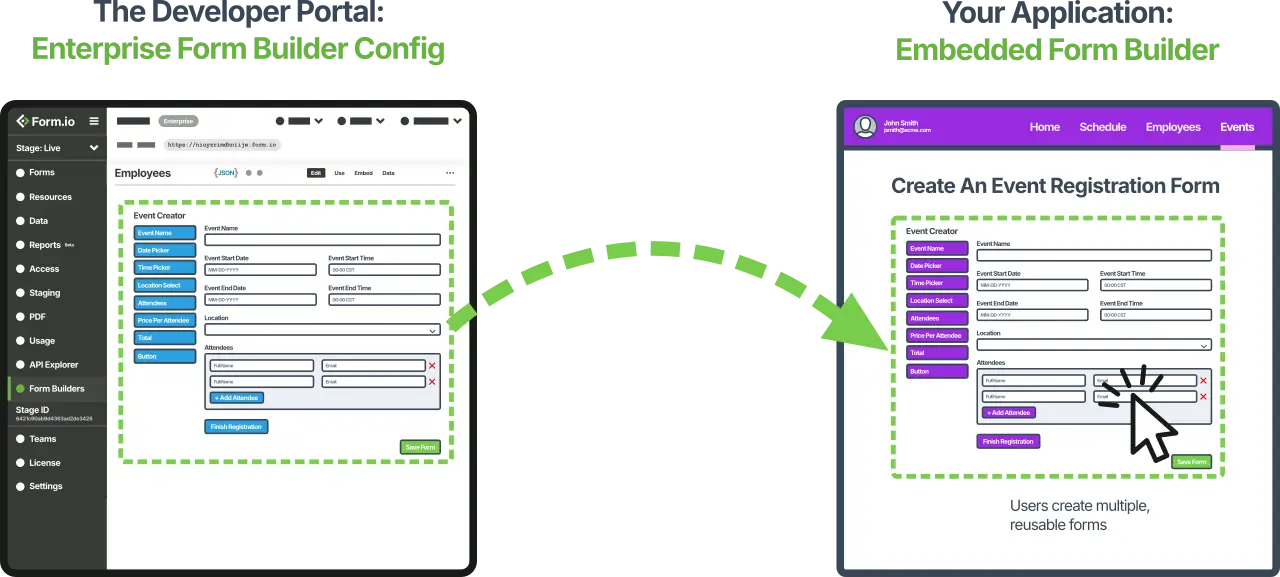
The builder is embedded directly into your application instead of sending users to a separate form portal. You decide which form-building experience they see, how it is branded, and which controls are exposed. That turns form creation into a product capability instead of a support ticket or a custom engineering request.
EFBM can be branded, configured, simplified, and embedded directly into the application experience you own. You decide which controls appear, how much complexity users see, and how form building fits the customer workflow. Non-developers can handle legitimate form variation while engineering keeps responsibility for the backend architecture.

Customer-created forms stay inside your Form.io-backed application boundary instead of becoming another third-party point solution. Your team controls where form definitions live, how submissions are captured, which permissions apply, and how collected data moves into the systems your product already depends on.
They can if you expose a generic builder with no platform guardrails. Form.io's EFBM is designed for customized, pre-wired form building inside your app, so teams can limit the experience to the components, labels, behavior, and permissions that fit the product.
No. Many EFBM use cases involve industry-specific forms that are structurally simple but need customer-by-customer variation. One customer may capture a person's name as first and last name, another may need preferred name, suffix, or organization-specific naming fields. Form.io lets teams customize the capture experience while keeping the submitted data normalized for the application.
Engineering still owns the application, deployment model, integration boundaries, and what customers are allowed to configure. The point is not to remove engineering from the system. The point is to stop routing every legitimate form variation through custom development.
You will bring the application context: who creates forms, what they are allowed to change, where submissions go, and which systems receive the data. Form.io will walk through the fit for embedded form creation, the guardrails that matter, and the likely implementation path. The first conversation is a scoping call, not a purchase commitment.
If EFBM is not the right layer, you will know before implementation planning begins.
When every customer form request reaches engineering, the product slows down for reasons that have little to do with the core roadmap. Embedded form building gives customers useful autonomy while your application keeps the rules.
"Forms are not just inputs — they're mission-critical data infrastructure," said Gary Wetzel, Co-Founder and CEO of Form.io.