

See how Form.io separates build-time AI development governance from runtime agent governance, while keeping both tied to the same schema-driven foundation.
An AI coding agent can create a form, scaffold a resource, wire an endpoint, and draft workflow logic before architecture review catches up, which is useful. The risk is that each agent makes its own decisions about data models, validation, RBAC, actions, and API patterns.
AI has not changed the underlying problem. It has made the existing requirements problem easier to see. You can move faster with Claude Code, Cursor, Windsurf, and other agentic coding tools, but the same business workflow can still become five incompatible implementations if every prompt invents its own model for intake, permissions, actions, and review.
This is development-layer governance. The concern is not a production agent acting on live data yet. The concern is AI-generated application infrastructure that looks complete while quietly bypassing the patterns you need every build path to share.
Prompt rules and code reviews still matter, but they are a weak standardization layer for agentic development. The stronger control point is the infrastructure layer where your forms, resources, APIs, actions, RBAC, and submissions already meet.
You need governed build-time primitives before runtime governance ever becomes the question.




The Form.io MCP Server connects your AI coding agents to a self-hosted Form.io deployment so they can read, create, and scaffold forms, resources, actions, APIs, and project structures inside your enterprise boundary. The agent builds against real platform primitives instead of fabricated prompt context.
Form.io Skills give your AI coding agents reusable guidance for application orchestration, form building, resource planning, JSON schema, actions, auth, API usage, SDK usage, and framework implementation. They reduce prompt-by-prompt improvisation by making your approved development pattern easier to follow.
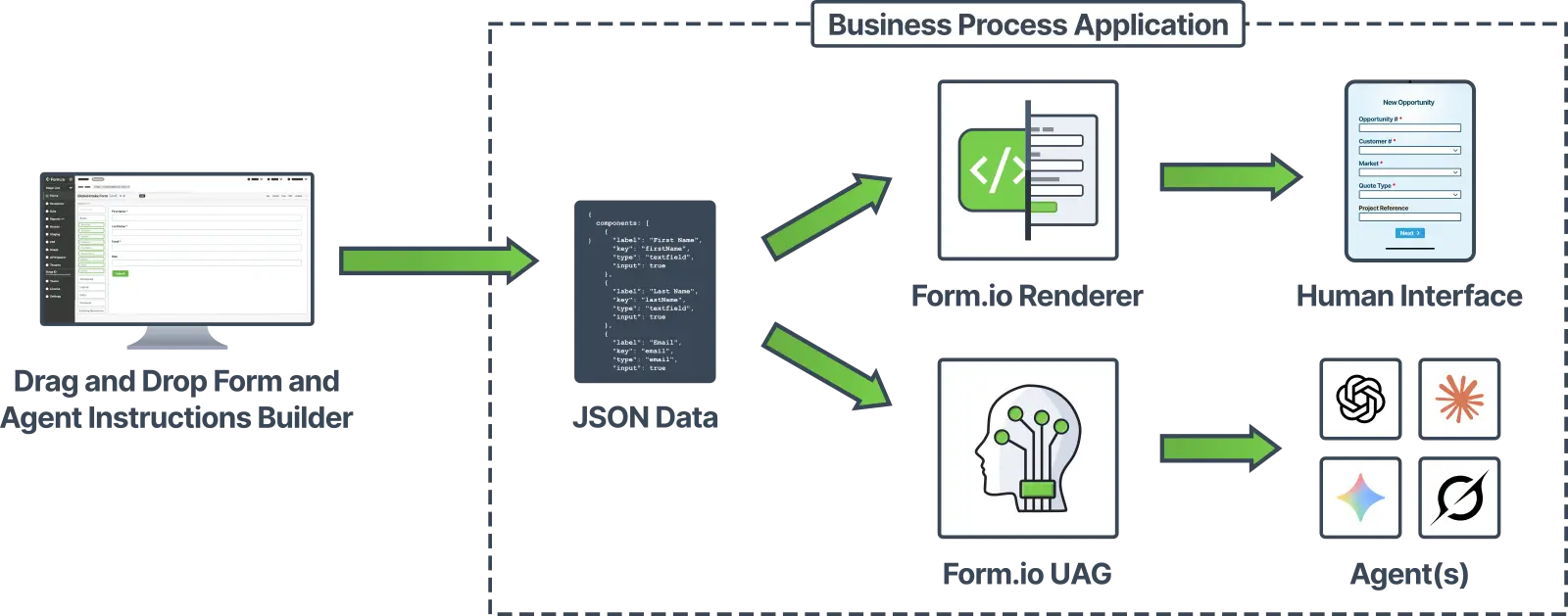
UAG is the runtime governance layer, not just another developer tool. It gives production agents dynamic context, guardrails, authentication, RBAC-aware data access, validation, and auditability when agents interact with live business workflows.
No. MCP, Skills, and the Agentic Coding Plugin give your AI-assisted builders a governed foundation to work against, but you still own architecture, deployment, integration boundaries, and release. The value is that generated work starts closer to the right Form.io primitives before human review begins.
That is the point. The build-time toolset is meant for the environment where agentic coding already happens. MCP gives tools access, Skills carry platform guidance, and the plugin brings both into your coding workflow so generated form applications follow patterns you can maintain.
No. Runtime governance is a different control surface. MCP, Skills, and the Agentic Coding Plugin help you generate better Form.io-backed applications. UAG governs production agents operating against live systems, with dynamic context, RBAC-aware access, validation, actions, and audit trails.
Usually, no. Enterprises often do not want to build every layer of form, API, permission, and workflow infrastructure themselves. They want to buy what already works, then keep enough control to fit their security, deployment, integration, and governance requirements.
Bring one AI-built or AI-planned workflow. Form.io will map where coding agents need MCP access, where Skills should standardize development, where the Agentic Coding Plugin fits, and where UAG is the better runtime control layer for live agent access.
If the issue is build-time drift, the AI Toolset may be the right conversation. If the issue is production agent behavior, UAG may be the right layer instead.
AI-assisted development can accelerate delivery, but it does not remove your responsibility for data collection, form behavior, validation, permissions, workflow actions, and release control. You can build almost anything with AI. The question is whether the foundation keeps the work in check once the prototype becomes part of your application.
The existing problems have not changed: requirements still need structure, sensitive data still needs governance, and form-driven workflows still need patterns you can operate after launch. AI has simply made it more evident that you need the right tools and stack before speed outruns review.
Form.io gives your coding agents a governed development path, then uses UAG when production agents need runtime governance.
The public formio/ai repository describes the developer-layer toolset: Claude Code plugin, MCP server, and Skills for Form.io primitives including forms, resources, roles, actions, APIs, auth, SDK usage, and framework implementation.