

See how the Form.io AI Toolset gives coding agents access to real forms, resources, roles, actions, APIs, and reusable implementation guidance inside the developer workflow.
A coding agent can create a working form in minutes. That is useful. The risk starts when each prompt also invents the resource structure, validation rules, role model, submission path, action behavior, and front-end integration pattern.
One developer asks for a customer intake workflow. Another asks for a claim form. A third asks for an internal approval wizard. Without a shared Form.io-aware toolset, each agent can produce a different interpretation of how forms, APIs, resources, and permissions should fit together.
That is not a runtime-agent problem. It is a developer workflow problem. The code may compile, the form may render, and the demo may pass, while the underlying application pattern drifts away from the way your team actually uses Form.io.
Developers do not need another wiki page telling them to be careful with AI-generated work. They need the coding environment itself to understand the Form.io primitives the application is supposed to use.
The Form.io AI Toolset gives agents a better starting point: real platform access, reusable skills, and coding-environment integration built around Form.io's schema-driven foundation.




The Form.io MCP Server exposes first-party operations for forms, roles, actions, project export, and project import. Agents can inspect and scaffold against the Form.io deployment your team actually uses instead of inventing a disconnected model from prompt memory.

The skill library gives coding agents guidance for application planning, form building, resource planning, JSON schema authoring, actions, auth, SDK usage, API usage, and framework implementation. The agent has a Form.io-aware path to follow before it writes.

The Form.io Claude Code plugin bundles the MCP Server and the skill library into the developer environment. Developers can ask for forms, resources, actions, access controls, project templates, or embedded UI work while the agent reasons in Form.io primitives.
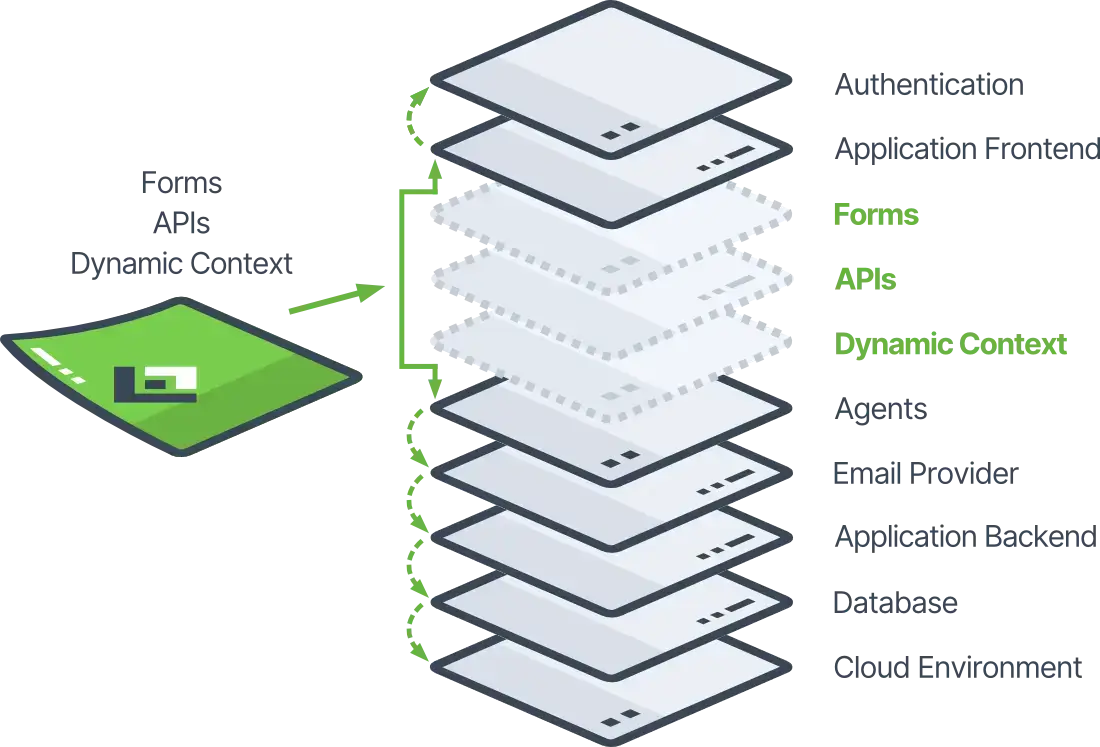
No. Developers still own the application boundary, release process, integration choices, and code review. The value is that AI-generated work starts with Form.io-aware primitives for forms, resources, actions, access, APIs, and schema instead of generic assumptions.
That is the intended context. The standalone MCP server can work with MCP-aware clients, while the Form.io plugin brings the MCP Server and Skills directly into Claude Code. The point is to meet developers where agentic coding already happens.
They can build Form.io-backed application pieces such as data models, forms, wizards, resources, actions, access controls, project templates, and embedded UI work. The surrounding application stack still belongs to your team.
Bring one form-driven workflow your team wants AI help building. Form.io will map which forms, resources, roles, actions, APIs, SDK patterns, and project templates the coding agent should work from.
If the problem is AI-generated development drift, this is the right conversation: make the Form.io pattern available where developers already prompt, plan, scaffold, and review.
AI coding tools can accelerate delivery, but speed only helps when the generated work follows a pattern your developers can maintain. Form.io gives agents a governed developer path through MCP access, Skills, and coding-environment integration.
The public formio/ai repository describes the toolset for Form.io primitives including forms, resources, roles, group permissions, field-based ACLs, server-side actions, project templates, SDK usage, API usage, and framework implementation.