

See how Form.io Universal Agent Gateway gives production agents governed context and controlled access to the same forms, resources, actions, APIs, and rules your human workflows already use.
The hard part of enterprise AI is not getting an agent to answer a prompt. The hard part is letting that agent touch production systems without creating a second, weaker path around the rules your teams already enforce.
Most teams try to solve runtime governance with prompt instructions, copied data, custom glue services, or one-off agent integrations. Those approaches can work in a demo, but they drift as soon as forms change, permissions change, or the workflow moves across systems.
Runtime agents need more than a smart model. They need dynamic context from the system of record, authenticated access, role-aware boundaries, validated submissions, controlled actions, and logs that explain what happened.
Universal Agent Gateway is the runtime layer for that problem. It turns existing Form.io JSON definitions into agent context and gives agents a governed way to read, validate, route, and act on structured workflow data.



UAG interprets Form.io JSON definitions for agents the way rendered forms interpret them for people. When a form, field, validation rule, resource, or workflow changes, the agent context follows the governed definition instead of depending on stale prompt instructions.
Production agents should not operate through a shadow permission model. UAG lets agents authenticate through the enterprise boundary, inherit RBAC-aware access, and work with governed forms and resources instead of loose copies of sensitive data.
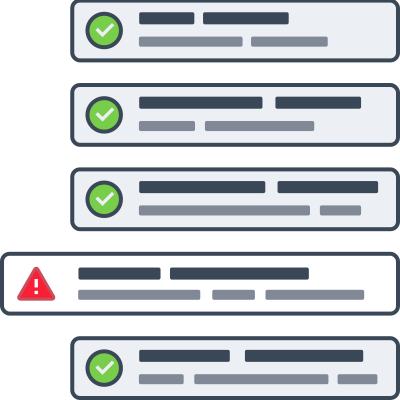
Agent output can become structured submissions, trigger configured actions, and move through existing workflow paths. The interaction is authorized, validated, logged, and tied back to the agent's identity so review does not depend on trusting a black box.
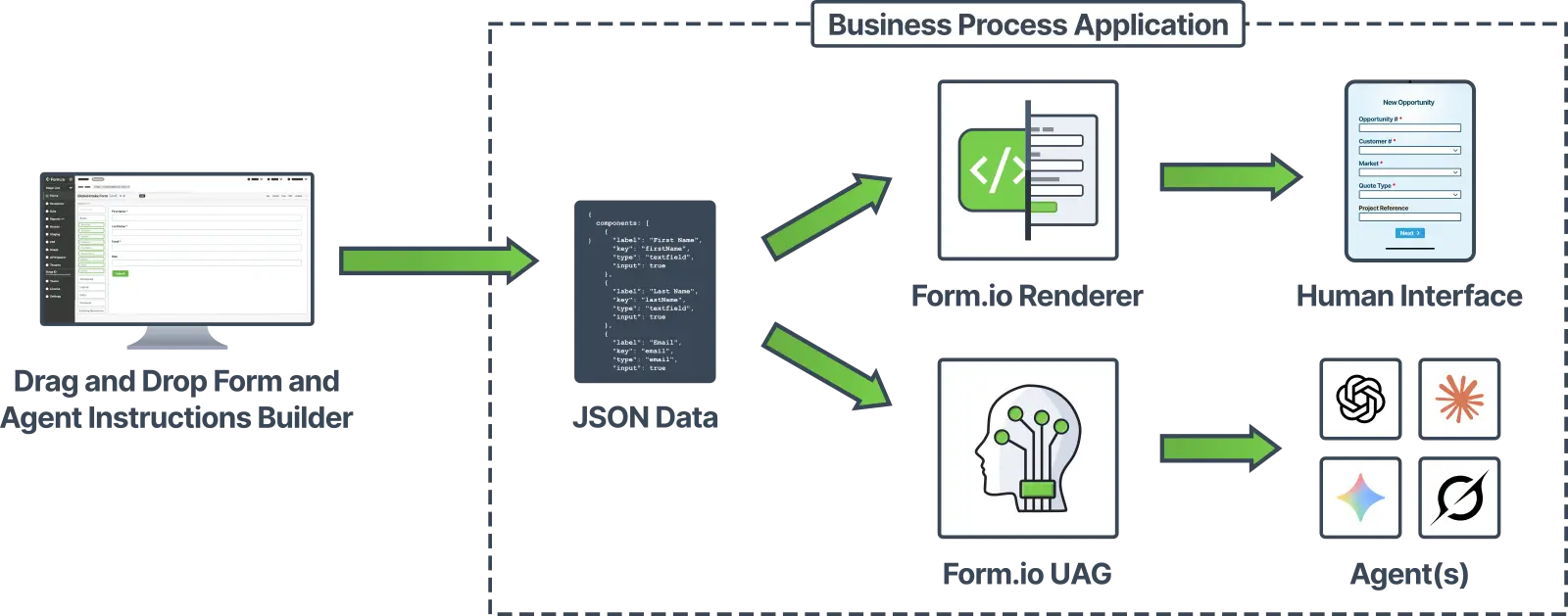
No. UAG sits between agents and the Form.io-powered data and workflow layer. Your team still owns the surrounding application, deployment model, integrations, and operational policy.
The governed JSON definition changes the context an agent receives. A new field, validation rule, role boundary, or workflow path becomes part of the agent-facing contract without retraining a model or rebuilding a parallel AI configuration layer.
Yes, when they are authorized to do so. UAG is built for agents that need to discover relevant forms and resources, assemble valid submission data, respect configured access boundaries, and trigger controlled actions into downstream systems.
Bring one agentic workflow your team wants to move beyond the demo stage. Form.io will map where the agent needs context, where it needs authenticated access, where validation must happen, and which actions must remain controlled and auditable.
If the problem is production-agent governance, this is the right conversation: make the live workflow rules available where agents read, decide, submit, route, and trigger work.
Production AI only becomes useful when agents can operate on real workflow data without bypassing the controls that make the system trustworthy. UAG gives agents dynamic context, governed access, validation, actions, and audit evidence from the same Form.io foundation.
The goal is not to let every agent improvise a new operating layer. The goal is to extend the governed data and workflow infrastructure you already use so agents become controlled participants in the process.